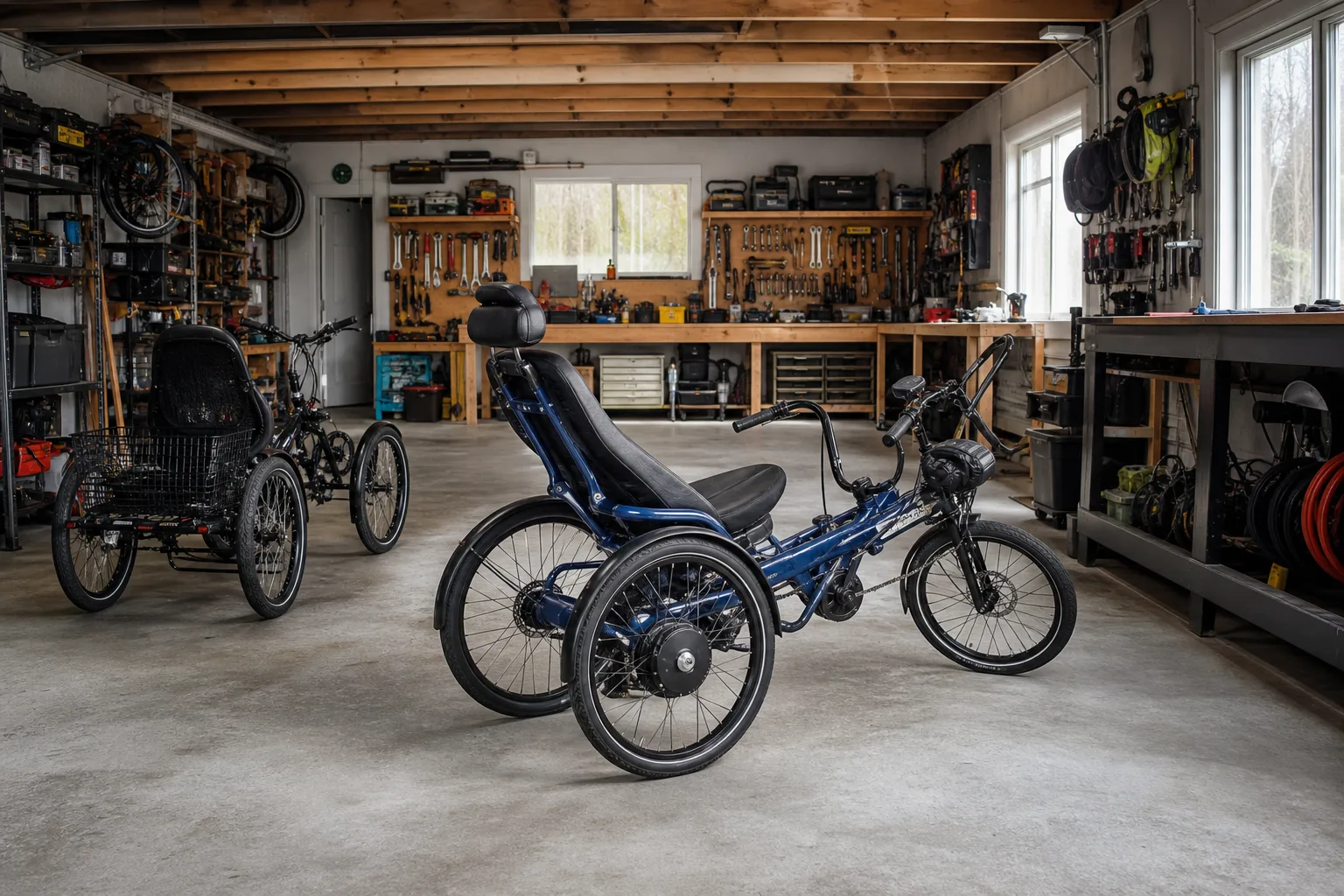
A motor on an adult trike is not the same purchase as a motor on a two-wheeler, because the machine underneath it is heavier, slower, and harder on drivetrains. Curb weights on the assisted three-wheelers listed through 2024 and 2025 commonly land between roughly seventy and ninety-five pounds before cargo, and that mass has to be started, stopped, and hauled uphill by a system rated for far lighter bikes. What a careful reader checks is not the peak wattage in the headline, but which parts of that system will need money over the years they intend to keep it.
Where the motor sits changes what wears out
A rear or front hub motor drives the wheel directly, leaves the chain and cassette alone, and fails, when it fails, as a sealed unit that gets swapped rather than rebuilt. A mid-drive turns the cranks instead, so it uses the gears, which means better hill behavior at low speed and a chain that wears noticeably faster under a loaded trike. On delta trikes with a single driven rear wheel, hub placement also matters for traction on gravel and wet grass. Neither arrangement is wrong. They simply move the maintenance to different places, and the mid-drive moves it toward consumables you can buy anywhere.
Watt-hours, not miles, and hills change everything
Range claims on listings are produced on flat ground, at low assist, with a light rider, and the number to work from instead is watt-hours: volts multiplied by amp-hours, so a 48-volt, 14-amp-hour pack is about 672. On a heavy trike carrying groceries and climbing anything worth calling a hill, planning around a consumption figure well above what a two-wheeler draws is the conservative approach, and halving the advertised range is a reasonable first estimate until you have logged a few rides. Two smaller batteries used in rotation often serve better than one large one, because charging both is easier than lifting either.
The battery is the scheduled expense
Lithium packs age on a calendar as well as on a charge counter, and most owners are replacing on time rather than on cycles. Replacement pricing quoted by shops through 2025 varies widely by chemistry, capacity, and whether the pack is proprietary, so the question to ask before purchase is whether a replacement is a catalog item or a special order tied to one importer. The Consumer Product Safety Commission oversees safety standards for e-bike batteries and chargers sold in the United States, and buying a pack certified to a recognized standard, from a seller who will still exist in four years, is the part of this decision that has no substitute.
Tires, brakes, and the parts a shop may not stock
Three tires wear at three different rates, and the driven wheel on a delta goes first. Brakes work harder because the machine is heavier and because riders who chose a trike for stability tend to brake earlier and longer, so pads on a motorized trike are a several-times-a-year item rather than an annual one. The items that stall repairs are rarely the motor: they are the proprietary controller, the display, the throttle, the torque-arm hardware, and the specific axle nuts on a wide rear end. Shops stock none of those for an unfamiliar brand, so confirming parts availability in writing is worth doing before the sale.
Adding it up over five years
A useful tally starts with the purchase price, then adds one battery replacement inside the five-year window, tires at least twice for the driven wheel and once for the others, brake pads several times, a chain and cassette more often on a mid-drive than a hub, and one shop visit a year for a system a home mechanic will not want to open. Assembly and tuning at delivery belong in that column too, since a trike shipped in a box needs alignment that most owners cannot do. Written down honestly, the ownership cost tends to be dominated by batteries and consumables, which is good news, because both are predictable and both can be budgeted for.
The motor is best understood as the part that makes the rest of the trike usable: it flattens the hill that ended the old route, and it turns a heavy machine into one that can be ridden home into a headwind. Choosing it well means choosing the supply chain behind it, and that is a question a phone call to a local shop will answer in ten minutes.